

Péinteáil
An artist struggling to find inspiration steps through a mirror and into a world where anything is possible, if only that world can be saved...


This piece of fiction was shortlisted for Uncharted Magazine’s 2023 Thrilling Short Story Award contest.
Péinteáil is pronounced “pain-tahl.”
Nora Lesley meandered down the sidewalk, piping hot Americano in hand. She had no expectations for the day apart from breathing in warm, early summer air and people watching in hopes of striking it rich with inspiration for a collection of artworks she had been commissioned to create for an acquaintance’s downtown yoga studio.
Royal blues and purples danced in Nora’s head; she imagined shining stars and glittering celestial bodies hanging on the studio’s walls. But something about the cosmic collection felt forced. Nora was best known for landscapes and, while she told herself these works were technically landscapes of the sky, excitement for the project was lacking this fine May morning.
Nora stopped at the intersection of Westover and Eighth for a sip of her espresso drink. Most Saturdays she turned right onto Eighth, strolled to Up and At ‘Em on Fifth for a second coffee with her best friend, Gabby. Today, however, Gabby was at rehearsal for her upcoming one-act play. The crossing signal waved Nora on; just as she was set to step along the path oft traveled, a woman’s laughter’s caught her attention.
“There’s a whole ‘nother world to see on this street!” the woman said, pulling her beau past Nora, down Westover. Nora’s eyes followed the pair to a corner lot, where people holding coffees and pastries browsed vendors’ tables.
“A sidewalk sale,” she smiled to herself.
Nora approached a table brimming with eclectic costume jewelry, knitting tools and patterns, dusty old records. At the adjacent table a woman sold elegant, life-sized statues and sweet statuettes. The bust of Picasso was almost too tempting so Nora tore herself away. She perused a table piled high in video cassettes and 90s memorabilia, and spent time admiring the model trains an older man was selling.
A beautiful, gilded book caught Nora’s eye and she stepped closer to the table that looked more like an outdoor library than a flea market booth. Her fingers caressed the worn spine; she lifted it to her nose, drank in the musk of an ancient, beloved book.
A light breeze caught the pages just so and the book opened itself to the dedication. It read, “For Moira, my nightlight. Remember Og Mandino said, I will love the light for it shows me the way, yet I will endure the darkness for it shows me the stars.”
Before she could wonder if the words were a sign, a nearby voice exclaimed, “Aren’t these darling?” and Nora turned to watch a college girl and her friend enthusiastically ogle kitschy porcelain kitten salt and pepper shakers.
Nora laughed, shook her head, stepped away from the books. On her way out of the sidewalk sale she glanced at a vendor selling rich oil paintings and charcoal sketches housed in lovely, ornate frames and sleek modern ones. At the side of the table stood a large, gold looking glass.
For the quickest moment, the way the sunlight hit the glass, it looked like gold dust from another world spilling through the frame. Nora shook her head and the magic dust dissipated. She laughed—big imaginations never die—and stood, tucked a strand of dark chocolate brown hair behind her ear, and stared again at the mirror.
It was just that: a mirror, the little corner lot’s goings-on reflected in the smooth glass. But when Nora turned to leave, rays of pale pink sunshine swirled; she stood, transfixed, drinking in the ethereal dance of blushes and golds that existed only to her and the mirror, and when she finally pulled her eyes from the scene and looked again, the mirror was nothing special. But there was something about it that compelled her to shell out seventy-five dollars and lug the old thing home.
Nora had the feeling that if she had left the mirror sitting, catching light alone, never to lay eyes on it again, her heart would have broken.
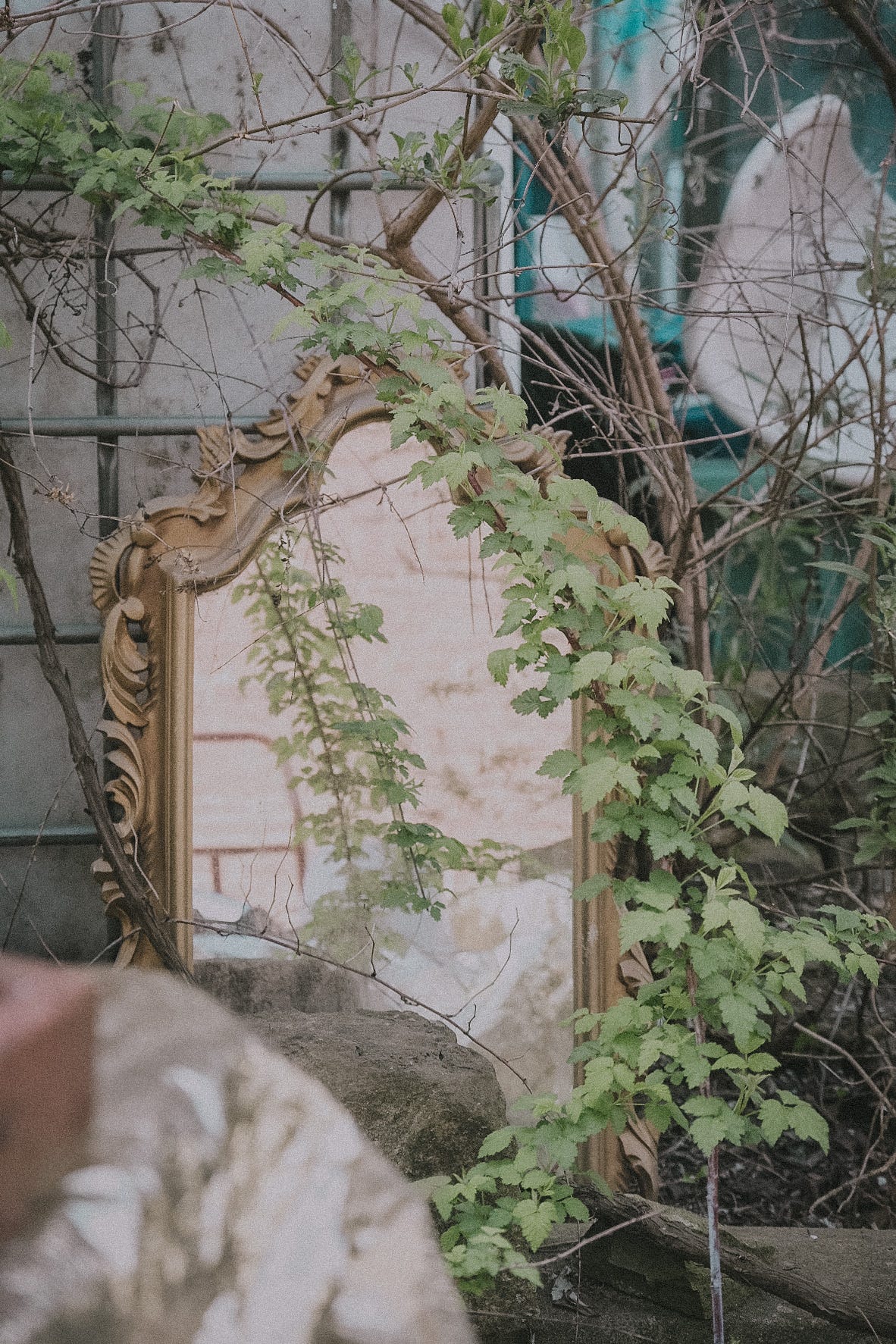
The mirror, lovely as it was, didn’t quite fit Nora’s aesthetic.
For three days, the mirror moved from room to room until finding a home in the cozy corner of Nora’s studio, a bright, welcoming space with paint-splattered hardwood floors and big bay windows. When morning light caught the mirror, golden flecks glinted off white walls, casting the space in an ethereal glow.
Mornings spent basking in that glow inspired a rosier palette and the beginnings of Nora’s fairy garden series.
One week after moving the mirror into her studio, Nora leaned back on her stool and studied a rough draft of the first painting in the series.
“It’s still too… too real,” she mumbled, frustrated. She wanted to paint something that at first looked and felt real, but was, upon closer inspection, more a dream than reality.
“This looks literally like winged people living in flowers,” she chided herself, letting out a long, low sigh.
The studio sighed with her and then all was still. Nora lost herself in thought. Just as she determined to resketch the trees, something moved in her peripheral.
Nora sat, frozen, not sure what she was afraid of, or if she ought to be; unsure, too, if anything had truly moved. But there it was again, soft movement coming from the corner that housed the antique mirror. Slowly, Nora turned to face the looking glass. It seemed different somehow; not dangerous, jus different, and so she slipped off her stool, crossed the room, and knelt beside the object that had all week long intrigued, distressed and, above all, inspired.
A dizzying kaleidoscope of colors filled her eyes.
Rich liquid gold dripped and swirled deep within the glass. The finest reds and richest pinks spiraled at the mirror’s center, cotton candy blues dotted the scene and pale yellows pulsed near the edges.
It was not, Nora was certain, a trick of the light.
Gold dust spilled from the glass into her world and Nora leaned closer, closer, body vibrating. Her breath fogged up the glass but the colors continued flowing; the tip of her nose touched the cool pane and glass rippled like placid water when a stone skips across. Nora had time enough only to notice a warm breeze against her cheek and a pleasant tingling as she fell gracefully out of her studio and into paradise.
A lush meadow spread before her, edged in trees wearing leaves of pure gold. Flowers of the richest purples and sweetest blues, of colors Nora didn’t have words for, swayed in a warm, buttery breeze. Women with supple skin lounged beneath the trees. Ladies and gents enjoyed fruits, cheeses and wine near a babbling brook; half-dressed bodies sunbathed, birds flitted to and fro, bees buzzed from petal to petal and everything was all the more glorious drenched in high noon’s pink haze.
Nora exhaled, realizing then she’d been holding her breath. She watched a butterfly flutter further into the meadow, noticed the soft dirt path meandering through greenest grasses. Somewhere in the far distance waves crashed; Nora’s gaze fell on the horizon, where roared a sea the color of dreams.
Is this Heaven, Eden, the Land of Milk and Honey? Nora wondered. And if so, how’d…
A white mist blew in from the ocean; Nora’s smile faded. The others paid the mist no mind, and Nora wasn’t afraid the way she should be; instead, she wondered, rather lazily, if the figure stepping out of the mist was the Angel of Death, if she had died and arrived here in the afterlife. As the figure slowly approached, 3arthly fears collected in a cold sweat on Nora’s brow. The mist inched ever closer; it was closer now, closer. And maybe Nora would have stayed rooted in the lovely meadow, waiting for the angel, but for the cawing of a crow and the memory of the world behind her.
Nora took one last, longing look at the gold-leafed trees and the approaching figure and then turned her feet and ran quickly, eyes fixed on golden mirror frame, until she reached it and tumbled through the portal from Heaven or Hell or Wherever She’d Been to her safe studio.
The mirror remained in the corner of her studio, though Nora wouldn’t touch it, and she didn’t know if she was afraid of going back to the magical meadow or scared it had been a glorious daydream. Whatever she had experienced, wherever she had been, it was a wondrous cure for artist’s block. In the days following her steps into another place, Nora had brought to life on her canvas the beginnings of a fantastical world, where paper sailboats glided on pink-tinged seas. Mermaids dressed in seafoam reposed against golden islands and island birds soared through tanzanite skies.
For days, Nora locked herself inside the studio, orchestral music filling the space, her hands dancing over canvas, breaking only to sip coffee or chance a glance at the mirror, which appeared to smile when she cast her eyes upon it.
No work of art is truly complete, but there comes a time when the creator can neither add nor take away anything more, when they step away from the piece to begin another.
After more than two weeks of tireless efforts, on a gray afternoon, Nora stepped back to admire the use of colors, her brush strokes. She sighed; Nora had never created a painting like this before, a work so big to look at it was an immersive experience. She extended her hand toward a mermaid, let it fall, stood silently, proudly, and then, with nothing left to add or erase, Nora declared, “It’s done.”
Sadness washed over her. Excitement, too, at sharing the piece with others, but when an artist realizes it is time to be finished with something they’ve poured their heart and soul into, a period of mourning is in order. Nora busied herself cleaning brushes and hanging the massive artwork. Night fell, and darkness, and an ethereal glow emanated from the corner of the studio.
The looking glass called and Nora answered.
Time did not exist in Péinteáil, where the blushing sun never set so night never fell, in this place where the world truly was one’s canvas, where a hungry woman could paint fruit into existence, where a tired soul simply need sketch shade for peaceful slumber. Days or years or minutes in this world were simply moments, and passed most happily. When Nora wanted water, a spring bubbled up beside her. When she longed for adventure, she merely drew excitement in the air and waited for a pirate ship to sail on the horizon.
Of course, it took time to create art from her mind, to craft and conjure in reality her tenderest thoughts and wildest imaginings. When Nora arrived in Péinteáil the second time, again the white mist gathered, but this time she did not run.
“I’ve been expecting you,” said the figure in a voice soft as rose petals.
Queen Lesa, the woman of the mist, was poised, and otherworldly, and her presence evoked joy. Nora did not yet know what this world was, but sensed magic.
As Nora toured the meadow, drinking in the landscape, squinting at the far-off lands, hillsides that climbed to the Heavens, dotted with Grecian monuments, Lesa explained how her father had escaped Nora’s world, The Other Realm.
“My father fought to break through the mirrors, to return to oneness with nature. The expectations of progress, the brutality, the violence and hatred that simmer just below The Other Realm’s marvelous surface–it was taxing,” Lesa said. “What you lack in The Other Realm, here you shall find in abundance. Inspiration arrives on a spring breeze, is the bird’s song, is one pleasant thought away. The struggle for creativity is cured; like a phoenix rising from the ashes, so too your great work of art shall be born. Should you wish to conjure a rose, hold out your hand and from fingertips it will grow. Gardens sprout in your footsteps, ballerinas dance in the town’s square of your dreams. Here in Péinteáil the only impossibility is aching despair, as it belongs to the world through the mirror.”
At first Nora painted the ethereal, ever-changing landscapes before her plein air, on an easel gifted by the Queen, using the richest color paints and softest brushes. It took many moments and much wandering, dreaming and socializing with the Baroque women and baby cherubs, but Nora eventually learned to raise her finger, concentrate on a color, and paint a tree trunk fiery red, or transform the tips of grass from green to fuchsia, or add polka dots to the clouds.
She felt the magic of Péinteáil firsthand on the day she imagined being on a magic carpet of finest silk. Nora had, some time before, learned to paint her mind into existence. One afternoon, she raised her finger to an empty space, bowed her head and brought to life a massive canvas, on which she painted a scene she’d always loved, Dorothy and her friends traversing the Yellow Brick Road, only in Nora’s work the four swayed, left and right and left and right, and the Emerald City actually shimmered in the distance.
She created works like that for a while, brought her world to life in this one, and then, inspired by creatures she’d noticed floating near the clouds, Nora absently imagined a magic carpet. With a half-smile she moved her finger like a paintbrush just above the lush ground. Nora closed her eyes, let colors swirl in her mind, transferred them from daydream to reality and when she opened her eyes there it was, and she was pleased, but not surprised, that when she curled onto the soft carpet it lifted her gently up, up and away.
Lesa’s laughter rang through the world as she watched Nora soaring through pink skies.
“Little girls don’t go falling into looking glasses often, and women with imaginations can’t see past their reflections,” Lesa said when Nora disembarked from her magic carpet and it faded into the nothingness from whence it came. “We hoped you would find your way here. One can never be sure, for you see, when a mirror is covered, the world goes dark, and when a mirror is shattered, the portal closes forevermore. I am pleased you are here and have tapped into your creativity, that the expressions of your heart, mind and whimsy are delighting all who dwell in Péinteáil.”
Nora meant to ask what the queen meant by shattered mirrors, but Lesa’s touch filled her with joy and she followed willingly to the much-anticipated Feast of Liberation, where centaurs and statues reenacted The Battle of Exod, during which King Soterios escaped The Other Realm, defeated base desires and sweated and struggled to find harmony with Mother Nature.
When the battle ended, smoke from the fire depicted lore, and the elves, creatures and humans who had found salvation in Péinteáil laughed and sang and ate and drank and the sun never set and the temperature never dropped and from time to time the clouds changed shape, or color, and the trees took on different hues and everything was convivial and Nora had never been happier.
Even paradise has secrets, Nora discovered, soon after the Feast of Liberation.
It wasn’t light that enticed her, it was the absence of color in such a colorful world that caught her attention. Black and white flowers frozen on the cusp of bloom; a beautiful landscape veiled in monochrome. It had potential to shine like scenes on the silver screen, but here, at Péinteáil’s edge, it was eerie; for a moment, Nora supposed she had reached the end of the world.
A boxy, crumbling archway groaned, as though awakened against its will by her presence. Afraid to know what lay ahead and afraid not to, Nora plunged ahead.
Tumbleweed turned over itself across an empty lot lined in a façade of the Wild West. A saloon’s doors creaked in imaginary wind, and Nora hurried through the set, into a studio where cardboard trees reached from stage to ceiling. Offstage, but within sight, glitzy costumes littered the base of a replica Eiffel Tower. A clapperboard bore the title Paris by director Clarence G. Badger.
Nora stepped further into what looked like, she imagined, Old Hollywood’s long-forgotten studios, a grid of sound stages and lots, all desolate and devoid of color. It struck her as tragic, the stately sadness of marvelous sets like the one featuring a full moon with a capsule sticking out of its eye. These exotic lands and humble homes, lonely and directionless under burned-out bulbs – where were the creators, what became of the audiences?
It happened gradually, the saturation of this black and white world.
First, Nora noticed sepia-colored stages, and when she reached the edge of coffee colors, she twirled through women holding green parasols and gents dancing—A Visit to the Seaside. Her frolic was short-lived, however, as Nora found herself prancing through dappled light, faux trees laughing at her carefree spirit as, wide-eyed, she drank in Technicolor.
Nora wandered through familiar worlds, where girls sang on trollies and explorers searched desert lands for lost arks, where gladiators fought valiantly and unsinkable ships sank.
Then the world faded to black like end credits.
Nora reached out her hand. It touched nothing, but she could move no further forward.
“Where am I,” she wondered aloud.
A projector whirred; lights shone brightly and a commanding voice from everywhere proclaimed, “The show will go on!”
A spotlight waved here, there, here again and stopped to illuminate a short, stout man in a stovetop hat. His Cuban cigar filled the lot with smoke and strong-smelling tobacco.
“So good to see you. It’s been some time since someone from there,” he waved his pudgy hands vaguely, “came looking for a good film. The movies, you see, are dead.”
“Oh, no they’re…” but Nora couldn’t tell him film was very much alive, not after traveling through the world of this artform, a world that went from monochrome to color and faded; she herself was guilty of streaming TV shows, of binge-watching television, and hadn’t set foot in a theater in Heavens, how many years?
“Ah,” the gent sighed. A pause.
“But you found us,” he grinned, bowing low. “Oh, you found us.”
From behind doors and curtains and castles and facades stepped faces Nora knew but couldn’t name. Each held their head high. All were regal, all dressed in the colors the public best knew them in.
“Places!” the gentleman belted.
Actors from all the ages took their places on their stages, in their times; the gent winked at Nora before moving, rather gracefully, away to direct his stars. Now that he had an audience, Nora heard him say, things would be different.
She couldn’t remember how she’d arrived and she didn’t want to go back to a world without color. For a moment Nora stood, unsure how to return to her part of Péinteáil, when the end credits lifted and a high note carried on a sultry breeze beckoned her onward.
Nora stepped from the studio lot world into a magnificent hall. Light refracted off ornate chandeliers, decorating seafoam green walls in dizzying patterns. Plush carpet guided her out of the foyer and onto the dignified balcony, overlooking the shiny oak stage floor.
A symphony of instruments stood at attention; a baton raised itself from thin air and, with the first movement, violin bows caressed strings, filling the space with a long, welcoming hello. Dainty music notes danced offstage and up, up to the balcony, past Nora, to the ceiling, and clung like snowflakes to the spectral chandelier. Light toyed with the notes, played on the rich red emblazoned in silver patterns that circled the sconce. Smaller lights sunk into the ceiling’s creamy brown ceiling, which changed color to the rhythm of the music, from dreamy yellow to spectral blue to passionate red and all hues and shades between.
“Oh,” Nora breathed aloud. Her voice caught in the plush gold tapestries before it could interrupt the fantastical sound of woodwinds and brass below.
Forever, or for but a breath, Nora stood, transfixed by the peopleless instruments performing. Her leg cramped, and she realized she’d been sitting, lost in the depth of sound and feeling, for some time.
“Wow,” she sighed.
“Wow, indeed,” Lesa said, and Nora jumped, startled to find herself not alone in the Realm of Music.
“The seven arts,” Lesa whispered, gesturing to the stage. “Oh, how they’ve changed, shape-shifted, peaked, and then set off again for the valleys of cheap tricks and remakes and re-recordings and half-baked ideas and no theme. Music is very much alive, cinema, too, though its struggling for a place in The Other Realm, where people are fixated on serialized storytelling,” and Nora thought this must mean television.
Lesa continued, “The Realm of Theatre continues to entertain with magnificent shows despite an inkling to deconstruct adored musicals or adapt film for stage. You’ve yet to see the Realm of Sculpture, but we must visit; it’s divine. The Realm of Literature is expanding, and though the Realm of Architecture has got awful cookie cutter, there are still magnificent spaces to behold.”
Lesa continued whispering and Nora leaned closer to catch her words.
“Of course, we are Péinteáil, the Realm of Painting, the finest of fine arts, though I much enjoy music,” said the Queen. “Post-modernism and AI threatens from The Other Realm, but inside the mirror we are, thus far, still free to manifest our most beautiful dreams.”
Sound stopped; the stage held its breath a beat before launching into a soaring rendition of The Lark Ascending. With a smile and full heart, Nora followed Lesa through the lobby, into a mirror, out of the Realm of Music, and back to the Realm of Painting.
A heartbeat here, a heartbeat there, that is for how long Nora missed her apartment studio, Saturdays with her best friend, The Other Realm. Life in Péinteáil was rose colored. Too majestic to leave. Wanderlust was cured with visits to the Realm of Sculpture, where passion larger than life moved visitors to tears, or with traipses through the Realm of Architecture, where one could easily lose oneself in octagonal barns and iron lattice and symmetrical stonework and pyramids and glass walkways protruding over cliffs. The cure for the painter’s blues was the dance of the fairies, the works of Shakespeare in the Realm of Theatre’s fabulous square. Longing for The Other Realm, a world so foreign to her now, felt unnatural when everything Nora needed, wanted, loved was here; yes, loved, because when she missed her old life, to which she did not try to return, Nora simply called into being an easel and brushes and recreated memories in paint beneath the pale pink sun.
Here in the mirror world there was nothing but time, and no shortage of inspiration, for art begets art.
It was on the fateful Evening—remember in Péinteáil, the sun does not set, and evening is implied in the way opalescent orange-pink cascades through the clouds, onto the meadow, soaking the world in surreality—Lesa appeared.
The grass twisted up, forming a flower-specked throne onto which Lesa sank. She nodded hello to Nora, not wishing to interrupt her work, then set about creating. Nora watched in awe the clouds swirling, curling upward, becoming a magnificent castle in the sky. Sky blue became cerulean blue; the castle nestled at the edge of a grassy cliff situated high above that sea, high above Nora and Lesa—all with the easy wave of the Queen’s small hands.
“How?” Nora asked breathily, adding a hint of shimmer to the unicorn’s mane in her modernized interpretation of Saint George and the Dragon, circa 1500; only it was a lovely warrior woman on magical horseback slaying the beast, which represented, to the artist, The Other Realm’s vulgarities.
“Practice,” Lesa said simply. “After my father left this world to me, I remade it in my own imagining, a little at a time. This meadow is my design; the ocean on the horizon, too, is of my making. The women reposing were painted by myself and the gold-leafed trees were so darling I made it impossible to paint over them.”
“That’s why they’re always gold, even if the tree trunk or leaf color changes?”
Lesa nodded.
The two painted together in comfortable silence while bees buzzed from electric blue flower to powder blue flower. A newcomer had, in a fit of exhalation, turned the entire meadow shades of blue and, rather liking it, all the women and men and creatures and Nora, too, had left it that way.
Now the blue faded gradually into quieter colors, beiges and off whites and dark, calming greens. Nora suspected it was Lesa who transformed the space from pulsing to serene.
More time passed; the meadow’s sweet colors darkened in a way that felt sinister. Beiges became mocha brown. The green was nearly black, now, and for the first time in her entire stay in Péinteáil, the eternally warm breeze bit as it grazed Nora’s neck.
Suddenly the pale pink sky blazed fiery red. Lesa looked up at the same time Nora realized the world was growing darker, the meadow colder and colder. Icy wind screamed as it blew through the realm. Creatures cut short their game of croquet and retreated into the forest. Birds squawked, flower petals curled into themselves and sirens shrieked as they slipped into the sea. Tree leaves wilted, Nora’s painting faded, Lesa cried out and Péinteáil was drenched in blackness.
Nora was suspended in nothingness. It felt like being shoved underwater by a wave; she did not know which way was up and which was down, her lungs ached and her ears rang and her head felt as if it might explode. She reached out, unsure she was really moving, waving her hands madly for something, anything, to hold onto. Her body lurched unsteadily forward, forward, and her fingers felt something smooth, like a stone.
“Nora?” Lesa’s voice was garbled, but it was her, the guardian of the Realm of Painting.
“Yes,” Nora shouted. “Yes, I’m…where are…what’s happening?”
The blackness tilted; Nora stumbled, body slamming against something hard.
“The mirror has shattered,” Lesa cried from somewhere far away. “When a mirror shatters and the land is shrouded in darkness, when beauty ceases to exist and all is blackness, the portal between realms shall close and art will be lost to the masses.”
The portal, closed. Art, lost forever to time. To be replaced by what? Nora wondered. What would The Other Realm be without fine art? Reverence, love, altruism, escape; a world without art is a barren wasteland…
Nora tried to put her thoughts into words but they drowned in the darkness that suffocated her. The cold grew colder; the blackness, blacker. Where was Lesa? Where were the others? Where was the Light?
“The world once was black,” she thought she heard Lesa say. “In the Before Times, before the Great Creator said let there be…”
The world shifted again; Nora landed against something massive and rough. Her fingertips explored the object, a beautiful, breathing object she knew so well.
Nora curled up in the tree’s base, rested her face against the bark.
“If only you could shine,” she whispered.
The tree quivered—a movement so small, Nora wondered if she had imagined it.
“Shine,” she whispered again, and again, a tremble. “Shine, shine, dear tree. Shine, you wondrous thing.”
Nora spilled forth her love for the tree, voiced every compliment she could, willed it to be brilliant, did everything she could to coax it into a light, glimmering beacon of hope. She whispered for what seemed like an eternity until the tree’s bark split and curved, forming paper of sorts, and Nora touched her fingertip to the bark.
“I. w-i-l-l. L-o-v-e the l-i-g-h-t,” Nora spelled aloud. “For it shows me the way. Yet I will e-n-d-u-r-e the d-a-r-k ness for it shows me the s-t-a-r-s.”
Stars! Those shining celestial dots in the sky, a sight Nora had not beheld since falling into Péinteáil, where night never fell. Stars. Stars, and the moon, that magnificent muse, the night’s radiant light. The stars and the moon. If only Nora could call out to them, if only she could—
She sat up, back straight against the tree’s trunk, the cold air beating against her face, the blackness so fierce it seeped into her bones. Nora shrugged off fear and doubt, didn’t dare let herself think how impossible this task was, and, taking a deep breath, raised her hand high, higher, willing the meadow to appear in her mind’s eye.
Blackness, only blackness.
She sat up straighter. Head pounding, heart racing, Nora forced the memory of the meadow on that first day, with pink sky and lush grass, to appear. Searing cold, darkest night, she would not them back into her mind. Her body shook, her head pulsed, her arm ached and—ah!, there it was! Puffy clouds, a sea on the horizon, and the scent of honey…
Nora imagined she was there, in that moment; imagined dark blue paint, pretended to color the rose sky midnight. She concentrated long and hard on silvers and whites and shades of; lovingly recreated the constellations.
When tiny twinkles of light began to shine, her shoulders relaxed and she let herself smile.
“Oh, beloved Moon,” she cried, lifting her finger to the Heavens and bringing that lustrous orb to life. “Light of the night sky, creator of, illuminator of shadows. Lead us back to color!”
The moon rose higher, higher, leaping from her imagination onto the blue velvet sky, coloring the meadow in rich greens and deep purples.
The flowers opened. Fairies burst forth from their petaled homes and danced beneath the full moon. For a moment, the meadow was still, a pause like the world catching its breath, and then centaurs and elves spilled from the forest into the moonlit meadow, singing songs of victory. A fire blazed; a warm breeze carried sweet melodies.
A soft, salty tear plopped onto Nora’s hand. For a moment she thought she was crying, but when she turned to see Lesa, she knew it was her Queen who had been moved to tears.
“Nora, the light,” Lesa breathed. “How can I ever thank you?”
Nora pondered the question while she and her Queen watched creatures of the night wander, for the first time, into Péinteáil and join the others in celebration.
Finally, Nora turned to Queen Lesa.
“Love the sun, but let the moon shine, too,” Nora said.
Lesa nodded.
They stood together, admiring the new depths of an old world and then, her masterpiece complete, Nora stepped out of Péinteáil, through the looking glass, and back home to The Other Realm.
Katherine Mansfield is a former staff writer for the local newspaper who now serves as full-time entertainer, chaser-after, and ever-enamored mother to two two and younger. When she can sneak in a few minutes to write, she pens sappy essays on motherhood, shoddy poetry, and short pieces of fiction. Oh, and she every once in a long while publishes novels, like her debut, “Original Works by Katharine Hughes.” How does she manage it all? By the grace of God and thanks to her wonderful husband’s support. And coffee, lots of coffee. :) If you like what you read, please like, comment or share with a friend. If you really like what you read, consider subscribing, or making a one-time contribution to this mother-writer’s caffeine fund.